


So… in my previous article, you saw that people often over-fold the river in 3bet pots. But does it ever feel like some of your bluffs in 3bet pots just don’t get through?
Maybe you’re missing some crucial details. Let’s add some nuance to our game and take a close look at one situation where bluffing is a mistake, revealing a broad pattern about bluffing in poker.
The Devil's in the Details: 3BP IP PFR in Tight Formations
In today’s article, we’ll focus on just one line: B-X-B as the 3BP IP PFR
- This happens when you 3bet preflop, cbet on the flop, both players check on the turn, and you bet on the river.
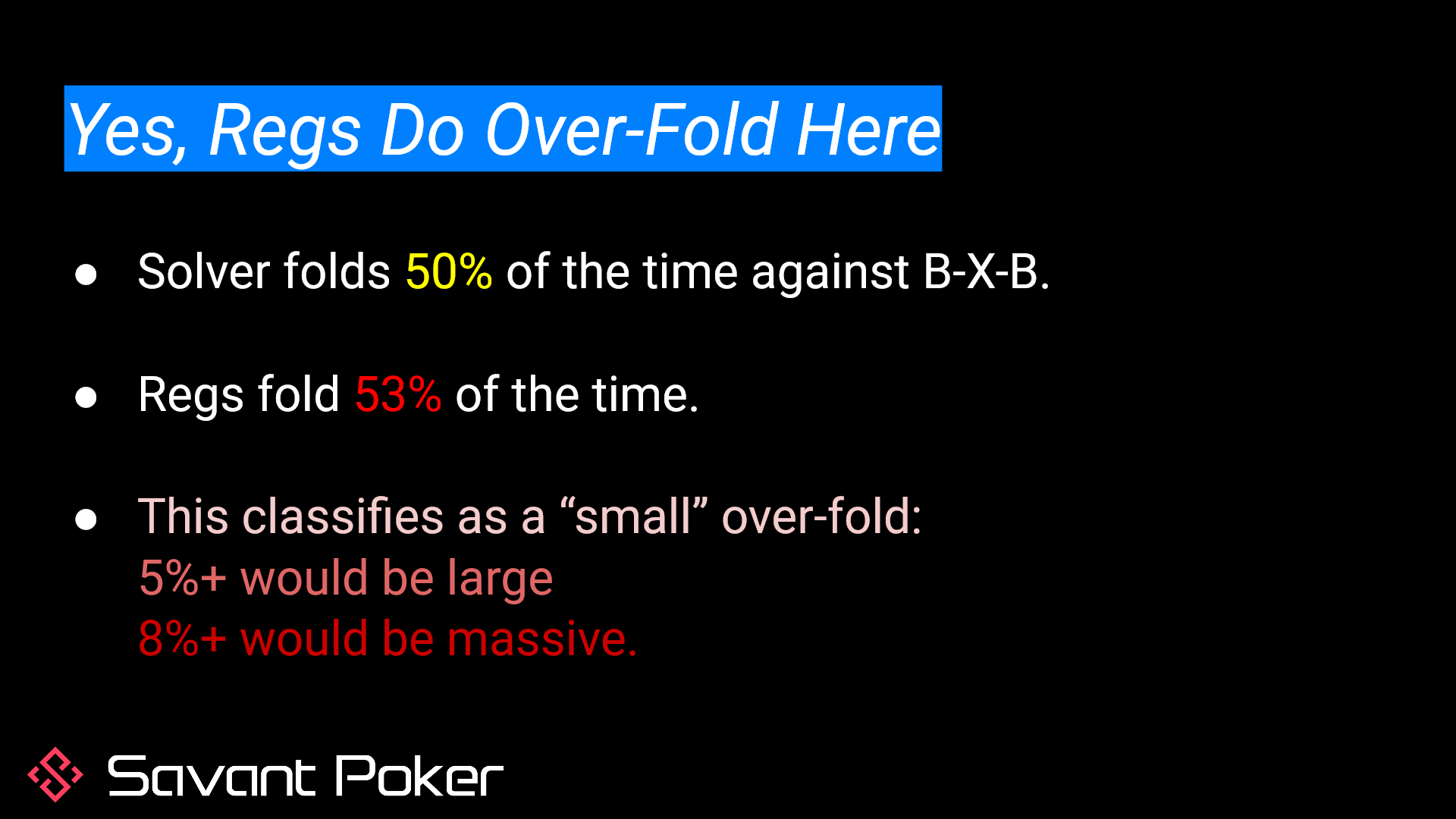
This means that on average, B-X-B is a good bluffing spot. It does not, however, mean that bluffing in every spot, or against any opponent, will be profitable.
- Note that this data mostly focuses on online poker, but will still often apply to live games.
When Does Bluffing Suck?
One factor that makes bluffing in B-X-B weaker is when the hand starts in early positions. In some lines, bluffing is equally effective from late and early positions. But in B-X-B, that’s not the case.
- This is because in tight formations, OOP’s defending threshold tends to be way higher than in wide formations; meaning the villain has to fold more “absolute strong hands”.
A naked top pair is often just a bluff-catcher in these spots, and will sometimes mix folds in the solver depending on the bet size.
- This can feel quite counter-intuitive for players to get right, although it will highly depend on the individual opponent's tendencies.
Deep Dive: A Massive Bluffing Mistake
Let’s say you’re playing against a slightly station-y reg in a 3bet pot. You’re HJ against UTG. The board is A♠ Q♥ 6♦ 6♣ 9♦.
This is a classic static high board where IP cbets at a high frequency for a small size and checks at a moderate frequency on the turn, arriving at the river with tons of weaker top pairs (A♥ T♥), second pairs and underpairs (Q♠ J♠ and J♣ J♦), and weak bluffs (K♠ J♠ and 7♠ 7♥).
Here’s what IP’s river range looks like in the solver:
The solver mixes many sizes, but mostly plays a split between a middle one (50 to 75% pot) and all-in.
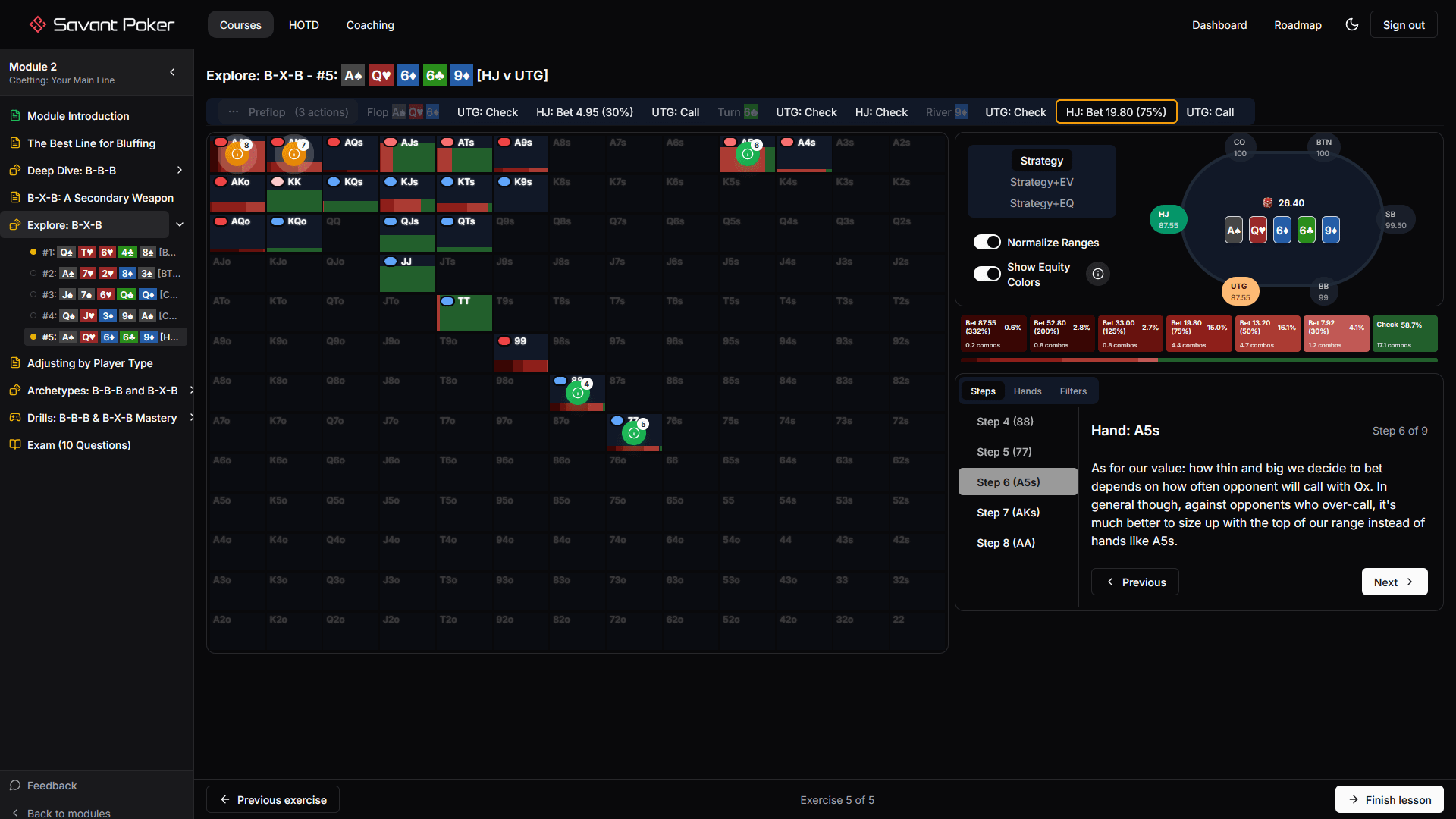
In this configuration, unpaired bluffs are very scarce: we’re left with only a few shreds of KJs and KTs. Although the solver will bluff them for the mid size sometimes, they don’t really make premium bluffs as they block some of OOP’s natural folds, like J♦ T♦.
Our lowest pocket pairs that got there and didn’t barrel turn, however, like 7♠ 7♥, make very good bluff candidates, since they unblock folds.
- As you can see in the solution, the solver will shove them quite often, balancing out AA.
To see if we are incentivized to bluff with these hands though, we need to look at OOP’s defending threshold:
Tight formation means a high calling threshold. OOP is already “allowed” to fold most of his Qx here facing 75% pot.
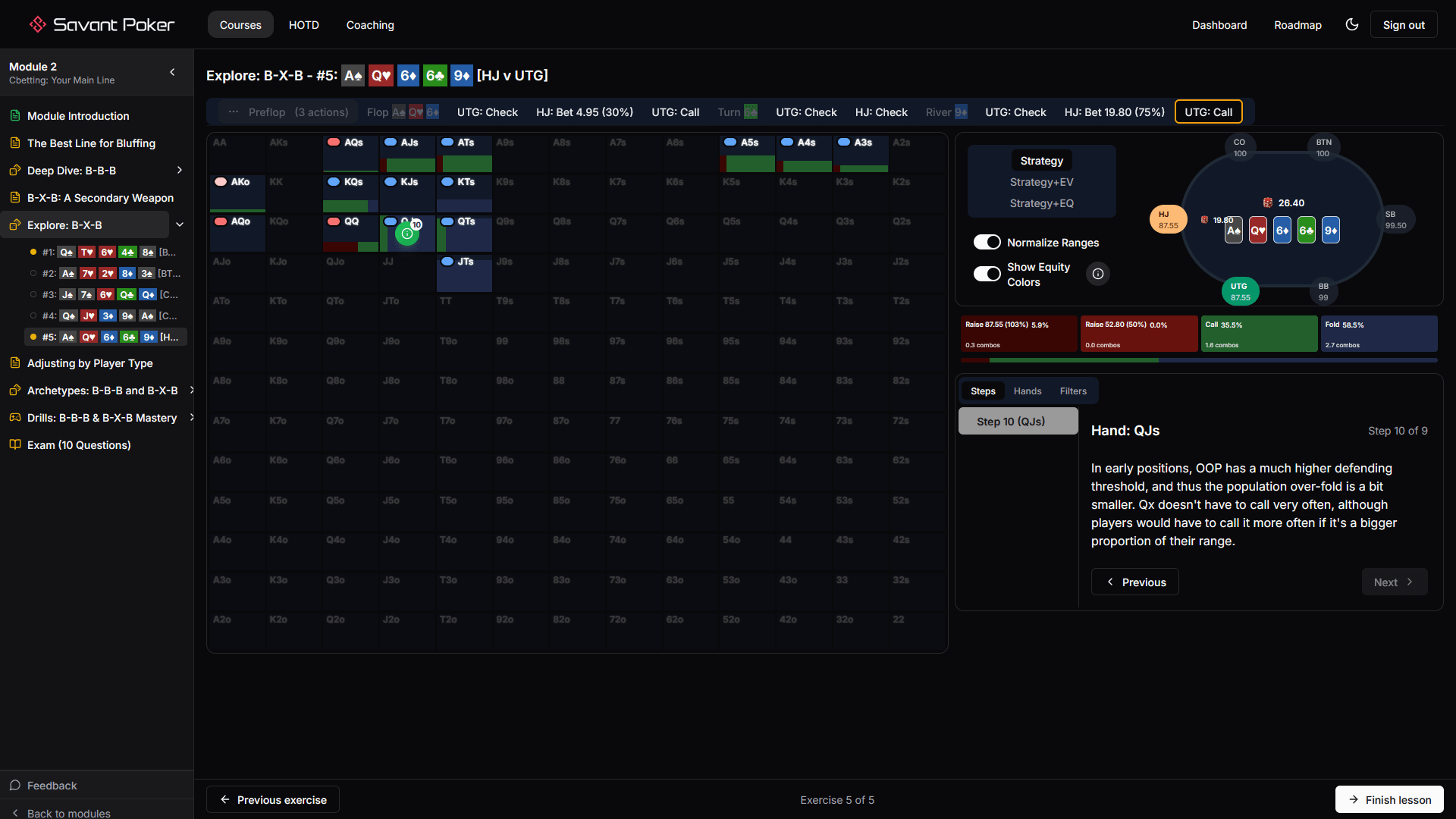
Top pairs like A♣ J♣ never fold to 75% pot. Only a shove would make them indifferent, but most Qx does.
If you ever bluff and get called by Qx in this spot: you’re getting exploited.
Against even slightly station-y regs, it‘s easy to see why bluffing here is bad.
-
There are far better spots for bluffing, even against these sticky regs.
-
Data shows even most station-y opponents will over-fold against certain lines, like B-B, which was described in my previous article.
But, poker is a complex game.
Knowing broad principles like “regs over-fold on the river in 3bet pots” and “bluffing is worse when ranges are tight” is a good start, but true mastery comes with understanding the interaction between mass data and solver theory in a large variety of spots.
With this goal in mind, ask yourself:
-
On what board types is bluffing probably better than A♠ Q♥ 6♦ 6♣ 9♦?
-
What other lines are probably better for bluffing?
-
And lastly… did you realize that this 75% river bet was not closing the action yet? ;) Do you think people would bluff-raise this river often enough as UTG? If not, what does this mean for your range?
If you liked this article and would like to see more, please leave a like and comment! :) It helps out a ton!