


Playing in position is incredibly powerful in poker: here’s one move that works even better in practice than in theory.
Put yourself in the following spot:
-
You’re playing in position and checked on the flop in a 3bet pot.
-
OOP bets 75% pot on the turn (their X-B node).
Here’s the magic of this spot: even if OOP is known to under-bluff, you’re often incentivized to over-call against this bet.
Why? Because data shows most regs over-fold against X-C-B. This means that according to millions of hands played, it’s often a good idea to call with weak hands in order to bluff them on the river.
Let’s take a closer look at how this spot works. This is CO’s (OOP’s) turn strategy in 3BP, BTN v CO. The board is 6♠ 5♠ 3♣ 8♦:
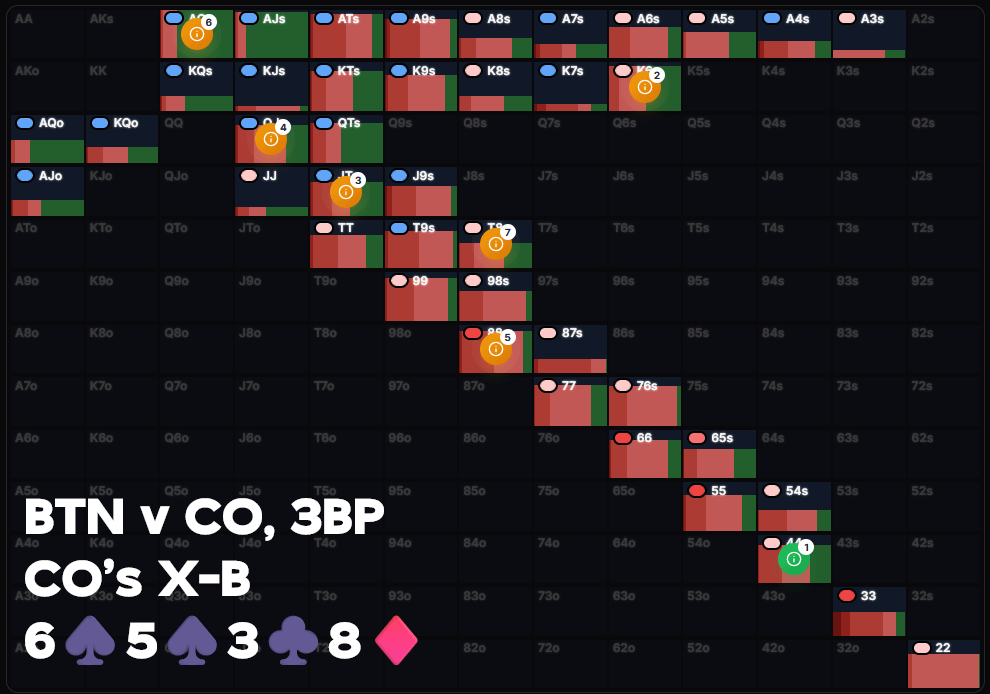
On low boards, OOP should bet small with a merged range that includes many weak pairs like 44, 6x, and 5x. These hands deny equity from IP’s overcards but aren’t strong enough to size up.
- There’s one big mistake that regs make here when they bet, but this isn’t the focus of this article.
Let’s assume that OOP is known to under-bluff and decides to bet 75% pot. Here’s IP’s defending threshold:
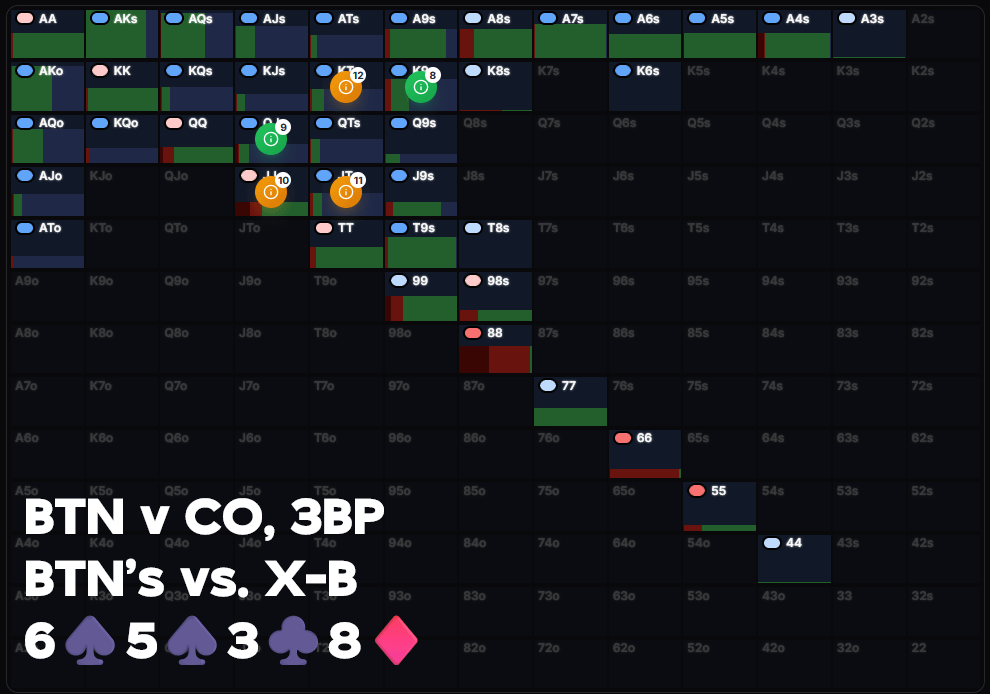
The solver’s calling threshold is usually around strong Ace-high and better.
But against most regs, we can defend a bit wider, calling with weak draws like A♣ 9♣ or K♦ 9♦. These hands should always bluff the river in X-C-B, both in theory and in practice.
- Note that this isn’t the only way to punish most opponents: other opportunities, like bluff-raising on the turn, are also highly effective according to mass data analysis.
Before you start using this exploit in-game, let’s add some nuance.
There are some situations where bluffing in X-C-B (and thus over-calling against X-B) is not favorable and burns EV:
-
If your opponent is very station-y with hands like weak pairs and Ace-highs. This will often be the bulk of their bluff-catchers against X-C-B.
-
If your opponent barrels incredibly often in X-B-B. This makes it less likely that you can take X-C-B, and can cause calling to be -EV overall, even if X-C-B is profitable.
-
If your opponent over-bluffs in X-B-B. This means they’ll check less weak hands that fold in X-B-XF, making X-C-B less profitable, especially if they love calling down with whatever hands they do end up checking with.
- Note that if they do over-bluff in X-B-B, over-calling on the turn (bluff-catching) is still the right move: just not with hands that can’t call down against the river barrel.
So remember these factors, and you’ll simply print EV against most regs. Data shows that this exploit is highly effective in 3BPs and SRPs against almost all unique player types – it’s just those few exceptions that you have to consider.
I mentioned that there were some other exploits you can take against X-B though: what do you guys think they are? 🙂