


I was reviewing my high stakes database ($5/$10+) and came across something interesting that you don’t see at low stakes. Check it out:

Here’s Why This Hand Interests Me:
I know some people are gonna want to run to the comments and call this high stakes hand a punt, but consider the following:
💥 According to mass data, regs over-fold against river donks.
-
According to the same large high-stakes database, solver only folds 40% of the time against river donks, but regs fold 48% of the time.
-
This is confirmed in lower stakes databases (50+ million hands).
Surprisingly, this is one of the biggest over-folded spots in poker. If you’ve read any of my previous articles, you’ll know that 8%+ over-folds are considered massive and are incredibly rare in the game tree.
According to the data, this spot is actually so good for bluffing that texture, player type, and position have little effect. Almost every possible combination of factors results in a large over-fold (5%+).
This even goes for smaller donks as well. Although larger donks (all-in specifically) produce far greater EV, regs over-fold against small donks by \~5%.
And in Theory, This Donk Makes Sense:
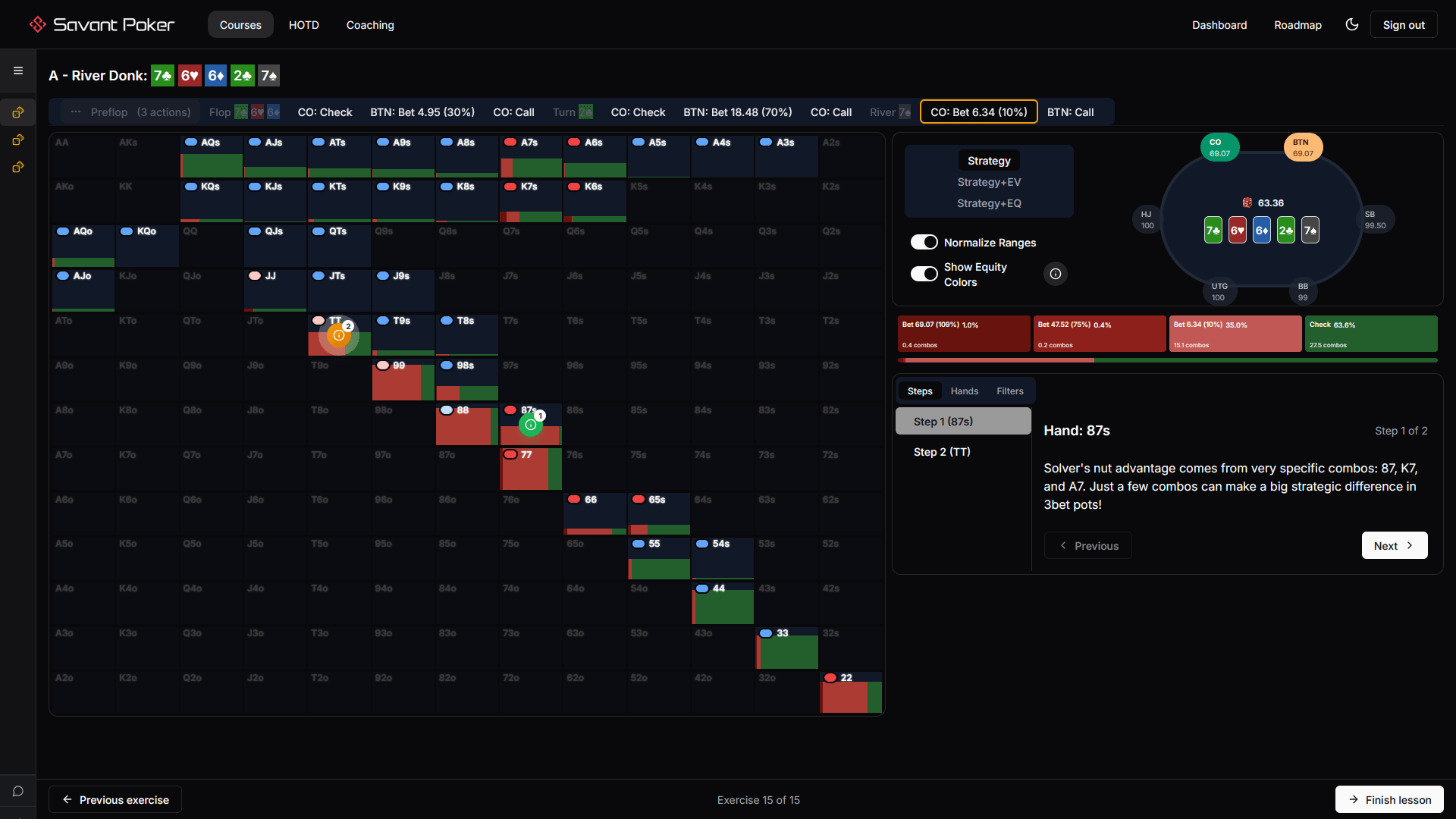
Solver gains a slight nut advantage on the river, since they have a greater number of 7x. This is an incredibly specific portion of their range: 87s, K7s, and A7s. These are hands BTN does not have (Exception: A7s)
If solver didn’t donk on the river, BTN would check back very often (up against a strong range), and thus those strong hands would be missing out on value.
4♣ 4♦ is able to donk because it has no showdown value and unblocks folds.
- 📊 Theory Side Point: donks tend to be smaller when ranges are less polarized. On club (flush-closing) rivers, CO would instead prefer to donk All-In as their range would be much more polarized.
On paper, it’s also very difficult for regs to defend appropriately in this spot. Take a look at BTN’s theoretical defending threshold:
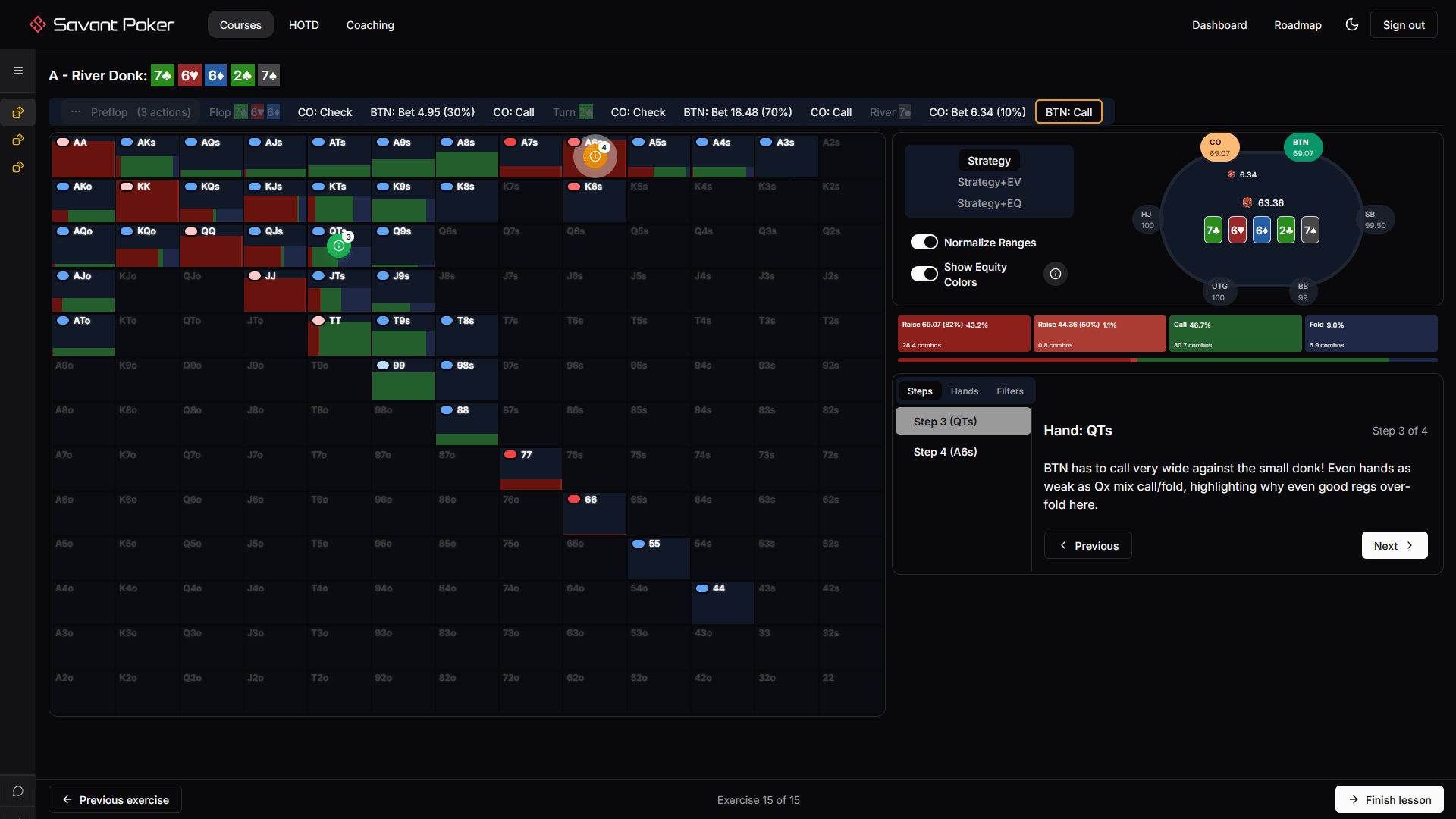
Hands as weak as Qx/Jx have to call down at a high frequency, and most players will just over-fold them.
I personally love connecting mass data to theory; if the data shows there’s an over-fold in a spot, it’s often due to a very low defending threshold in the solver.
But Something’s Not Right.
Just because data shows that regs over-fold against river donks, doesn’t mean we can expect to implement this strategy right away and expect massive over-folds.
There are other factors to consider. For example, it’s likely that regs only over-fold against river donks because they suspect that people under-bluff significantly.
Plus, if you’re trying to play at least somewhat similar to the solver (recommended online at higher stakes) it’s incredibly difficult to get river donks right, especially in 3bet pots.
- Pots can get really big, and the last thing you want to do is donk in a spot where it’s clearly much higher EV to check.
⚠️ For these reasons, I cannot in good conscience recommend anyone start donking rivers after simply reading this article. If you want to start donking rivers, you need to put in some work to at least understand some theory behind this line.
So, I want to hear from you guys:
-
What do you think about this hand?
-
Does this sort of analysis make sense?
-
Is there anything else I missed about why river donks might not be effective?