


Hey, it’s Gleb again!
Following up on a previous article I wrote here, I’ve had a few people ask me how to play against fish in general.
I figured I’d turn this into a series, starting with a line most players hate facing, even though there’s a big edge to be gained.
BTN vs BB, SRP. Flop [Kd] [Th] [2s]. Fish donks 50% pot. Holding [9s] [8s], what do you do?
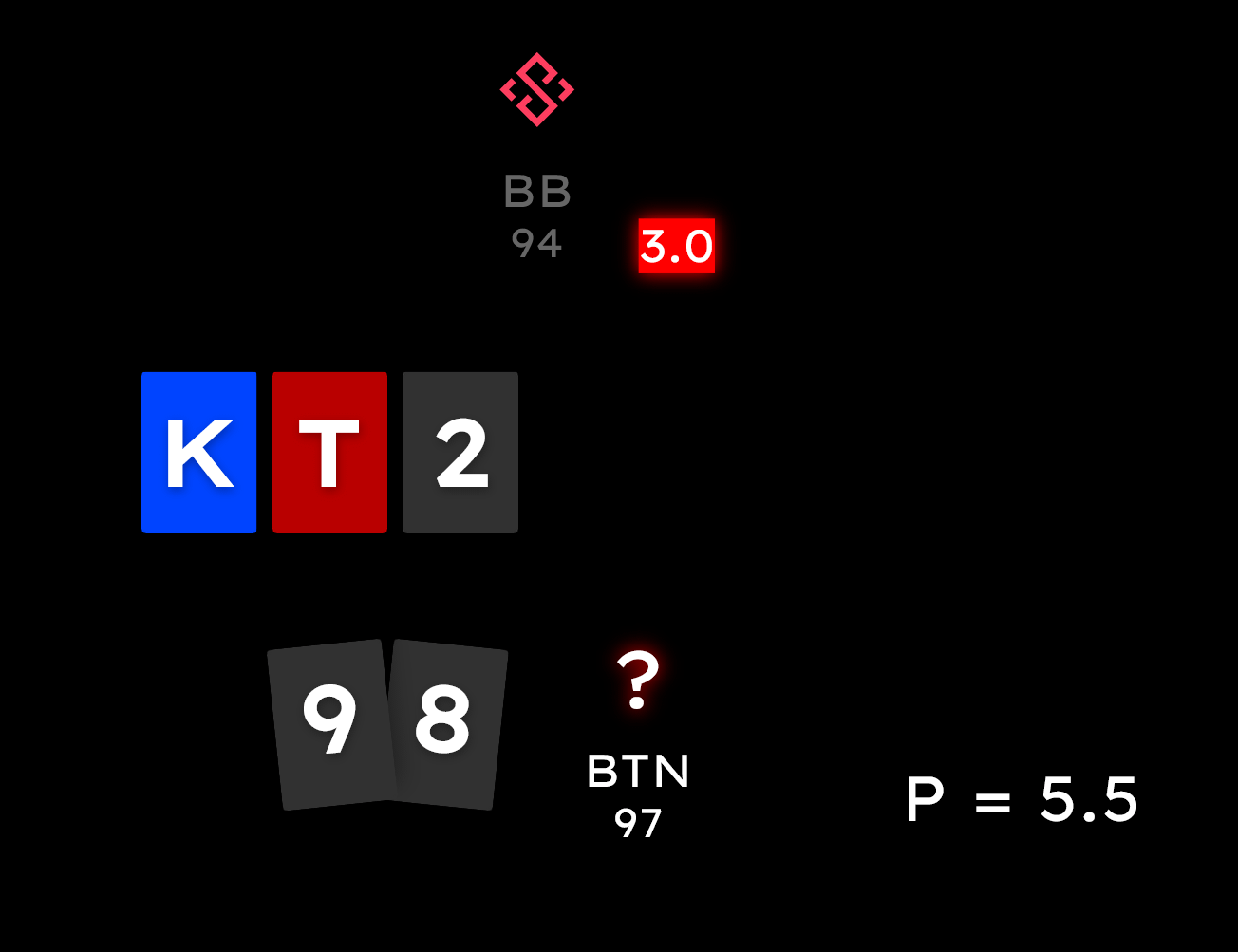
Most regs feel confused here, even though they’re up against a weak opponent. At some point, most regs were just like the fish, but they’ve since forgotten how they used to play these spots.
And clearly, knowing how to play against donks is important. The average fish donks five times as often as the solver does overall in this position.
Here’s Where the Data Comes In
It gives us a reliable understanding of how fish play, and how to exploit them.
In the donk line, mass data (MDA) shows that fish bluff roughly the correct amount. This means that on K♦ T♥ 2♠, they’ll have tons of weak top pairs, second pairs, and plenty of bluffs.
Here’s what it probably looks like:
The average fish just donks often with all sorts of hands. The specific range composition in the sim isn't meant to be entirely accurate, as that's almost impossible to estimate with high precision.
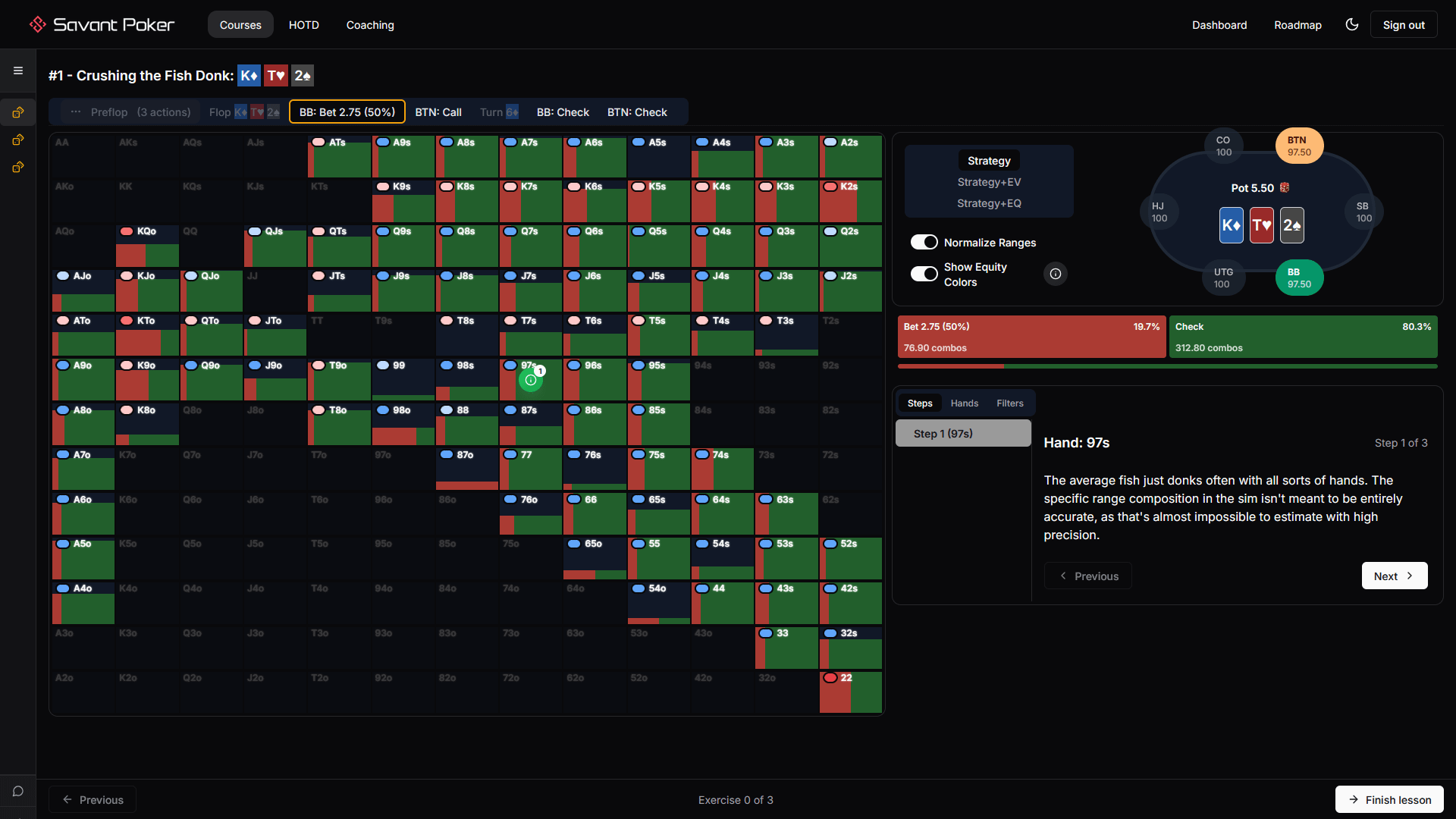
Of course, fish would have a wider range preflop. The specific range composition doesn't matter, this image is just to demonstrate.
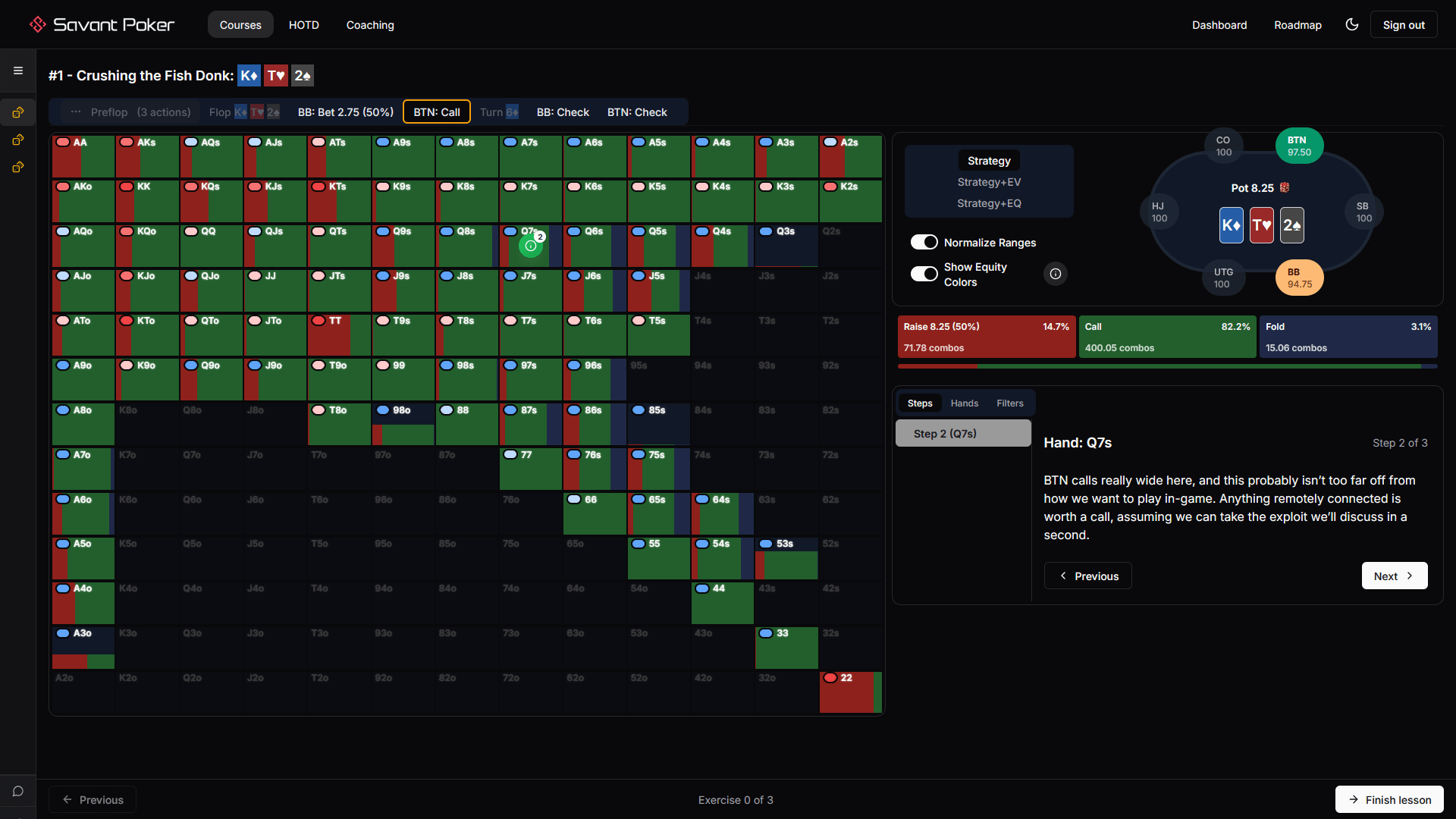
And just for fun, here's how wide BTN calls in this semi-realistic sim:
BTN calls really wide here, and this probably isn’t too far off from how we want to play in-game. Anything remotely connected is worth a call, assuming we can take the exploit we’ll discuss in a second.
How to Exploit It
There are a few clear ways to punish this strategy:
-
Raise a lot on the flop.
-
Attack them when they instead check on the flop.
-
Over-call against the donk, as we’ll see shortly.
It Gets More Complex: After donking, the average fish will not barrel often enough and actually under-bluff a bit on the turn.
This strongly depends on the type of fish:
-
Your passive fish will mostly bet strong hands, not understanding the importance of checking strong hands OOP.
-
But your loose aggro whale will still over-bluff quite a lot.
However, the key exploit lies in what happens when they donk the flop and then check on the turn.
You Can Bluff – a Lot
Fish over-call turn stabs, but over-fold massively to river barrels (your C-B-B line).
In fact, taking this line nets you an extra \~0.5-1.5bb with bluffs on average per hand. And because fish just donk so often, you can absolutely print in this line.
Here’s how you might want to play after they check:
Against the average fish, we want to bluff 100% of the time. Balance doesn't matter against them. Our strongest hands can overbet, and our medium-strength ones can bet 75% pot.
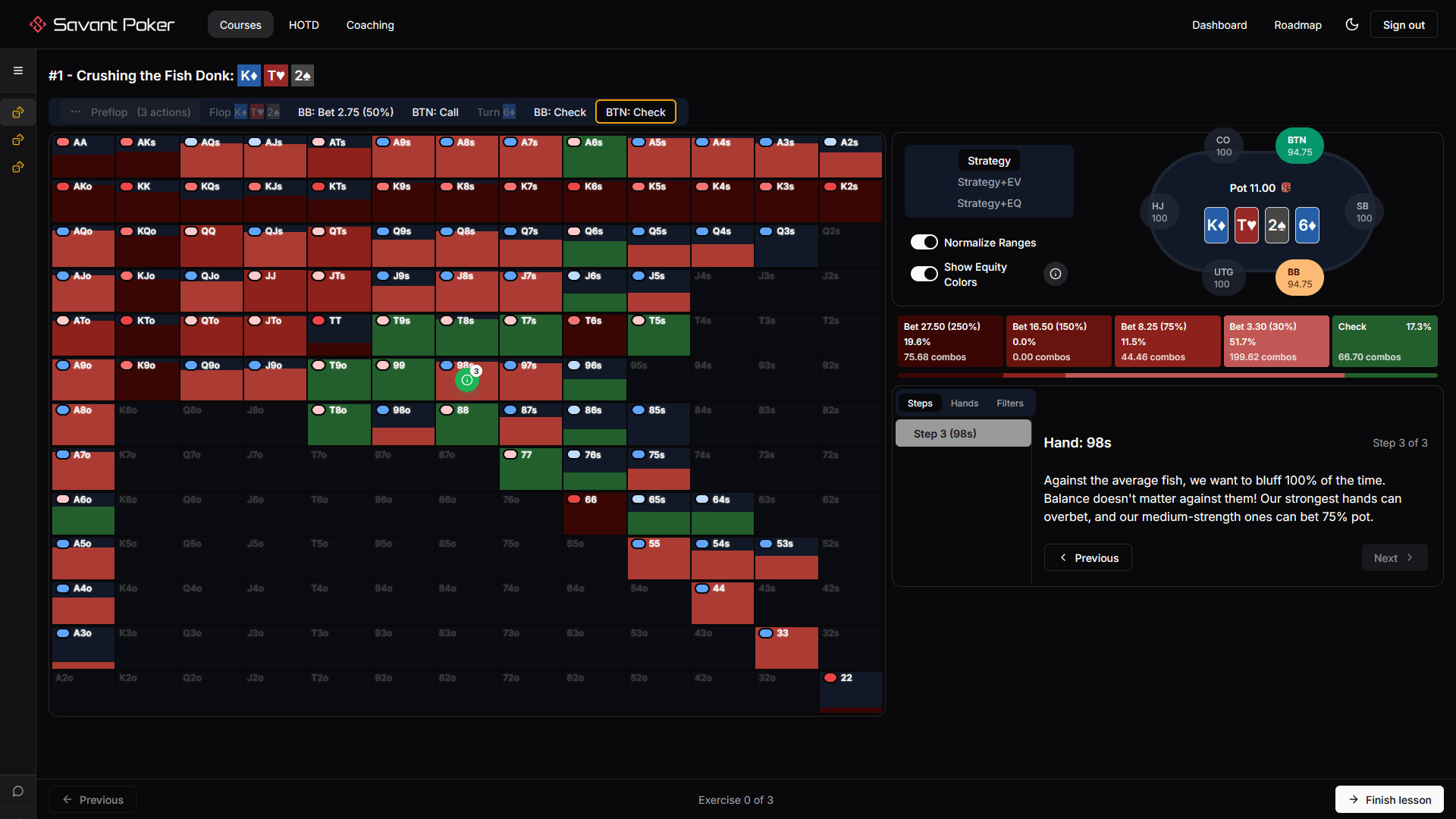
Make sure to use a small turn bet, as this keeps their range wide, ensuring you get that river over-fold.
⚠️ Just be Careful:
Your “calling station” will over-call against this line, and bluffing against them is disastrous.
That's not necessarily your loose player: tons of passive fish are calling stations. Watch out for players who frequently call Ace-highs and weak pairs.
And no, balance doesn’t matter here. Fish just aren’t good enough to counter-exploit you (otherwise they wouldn’t donk). Bluff 100% of the time in this line.
Curious if anyone else has been using this line? Any big hands where this worked (or backfired)?
Let’s share some exploit gold! 💪