


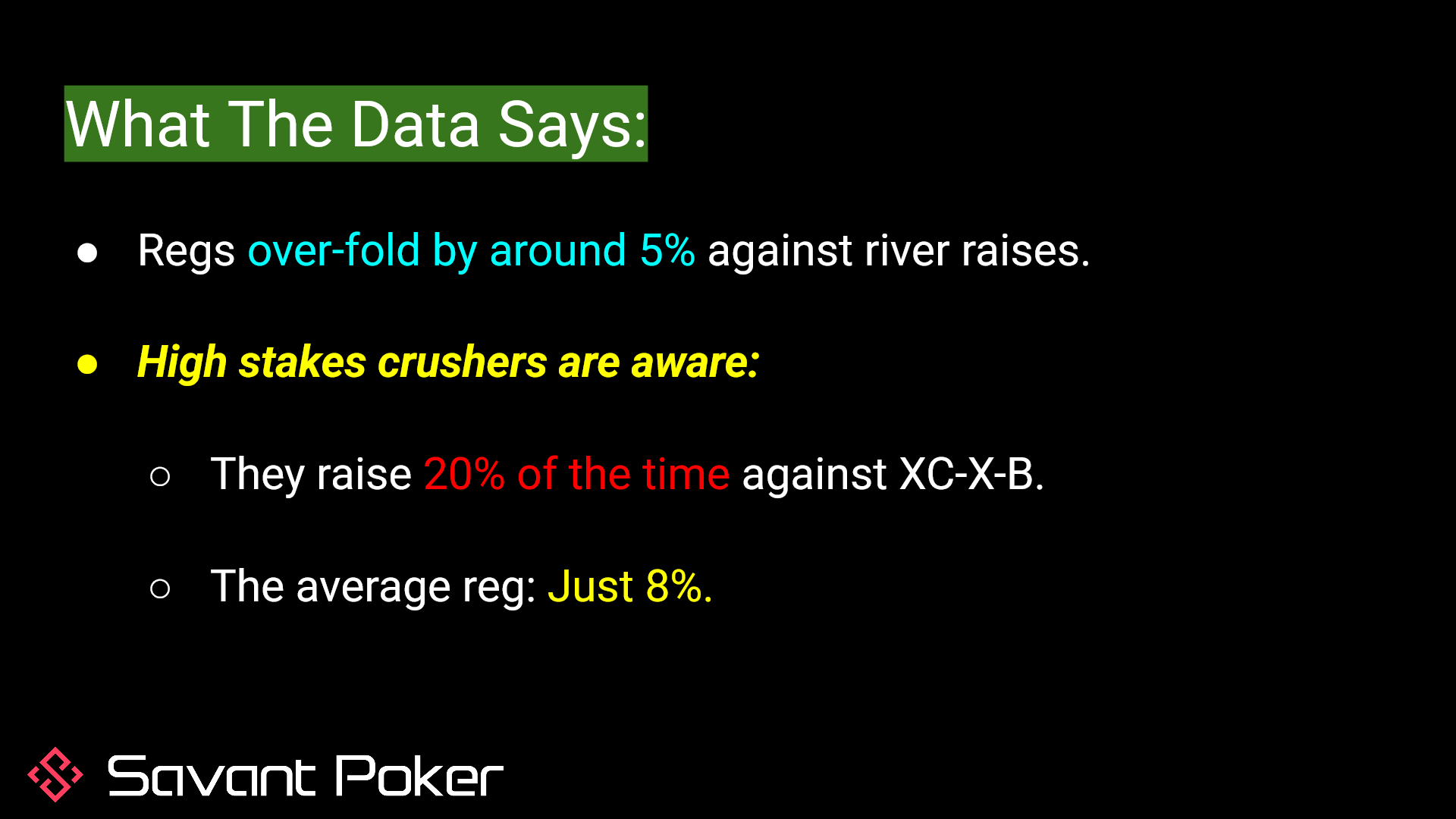
Almost every single reg doesn’t bluff-raise rivers often enough.
That’s not an opinion – that’s simply the results of extensive database analysis.
But check this out: This is a sample of 4 of the best red line crushers at high stakes. (Andrew Graham, Taisto Janter, Linus Love, Markkos Ladev)
A 200k sample of the best red line crushers at 1knl+:
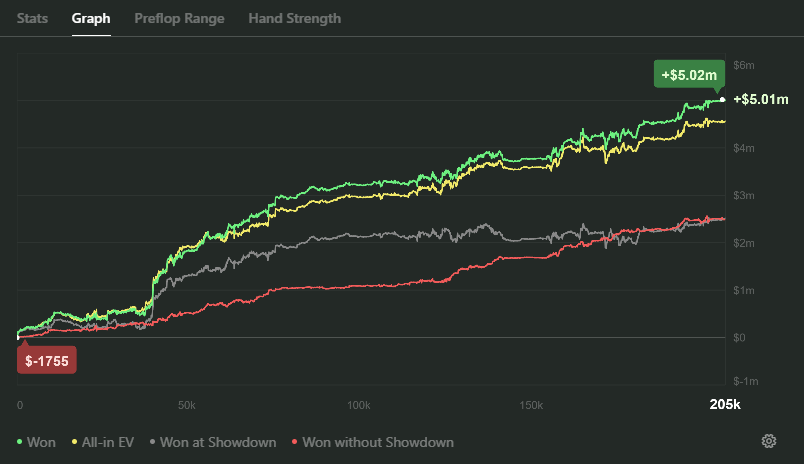
One Big Difference: they raise rivers more than twice as often as the average, red-line-losing reg.
According to the data and my experience working in poker-full time for years, this is a powerful red-line exploit that works at low, mid, and high stakes.
👉 Zooming In: A 3Bet Pot Raise
Let’s figure out exactly why river raises are so powerful, zooming in on one specific line: Raising against XC-X-B as the 3BP IP PFR.
-
This means you 3bet in position preflop.
-
You then cbet the flop, turn went check/check, and OOP leads into you on the river.
-
But there’s a catch: Raising against overbets loses EV.
-
Vice versa, raising versus smaller bets (30-50% pot) over-performs as we'll explore shortly.
⚠️⚠️⚠️ And MOST Importantly, It doesn't work in all lines. XC-X-B is a common under-used one where it does work.
- Some other lines where it also works well are vs X-B-B and vs X-X-B in many single-raised/3bet pot spots.
In my coaching, I encourage students to bluff-raise rivers more often. It’s something I also learned back when I was in a CFP playing professionally.
👉 Deep Dive – Why it Works:
Let’s take a close look into just one XC-X-B hand: BTN v CO, Q♠ T♥ 6♥ 4♦ K♦
-
BTN cbets range for 30% pot on the flop, turn goes check/check, and CO re-opens for 30% pot on the river.
-
This is what their “optimal” strategy looks like:
ATs: solver's thinnest value bet, which most regs would refrain from betting.
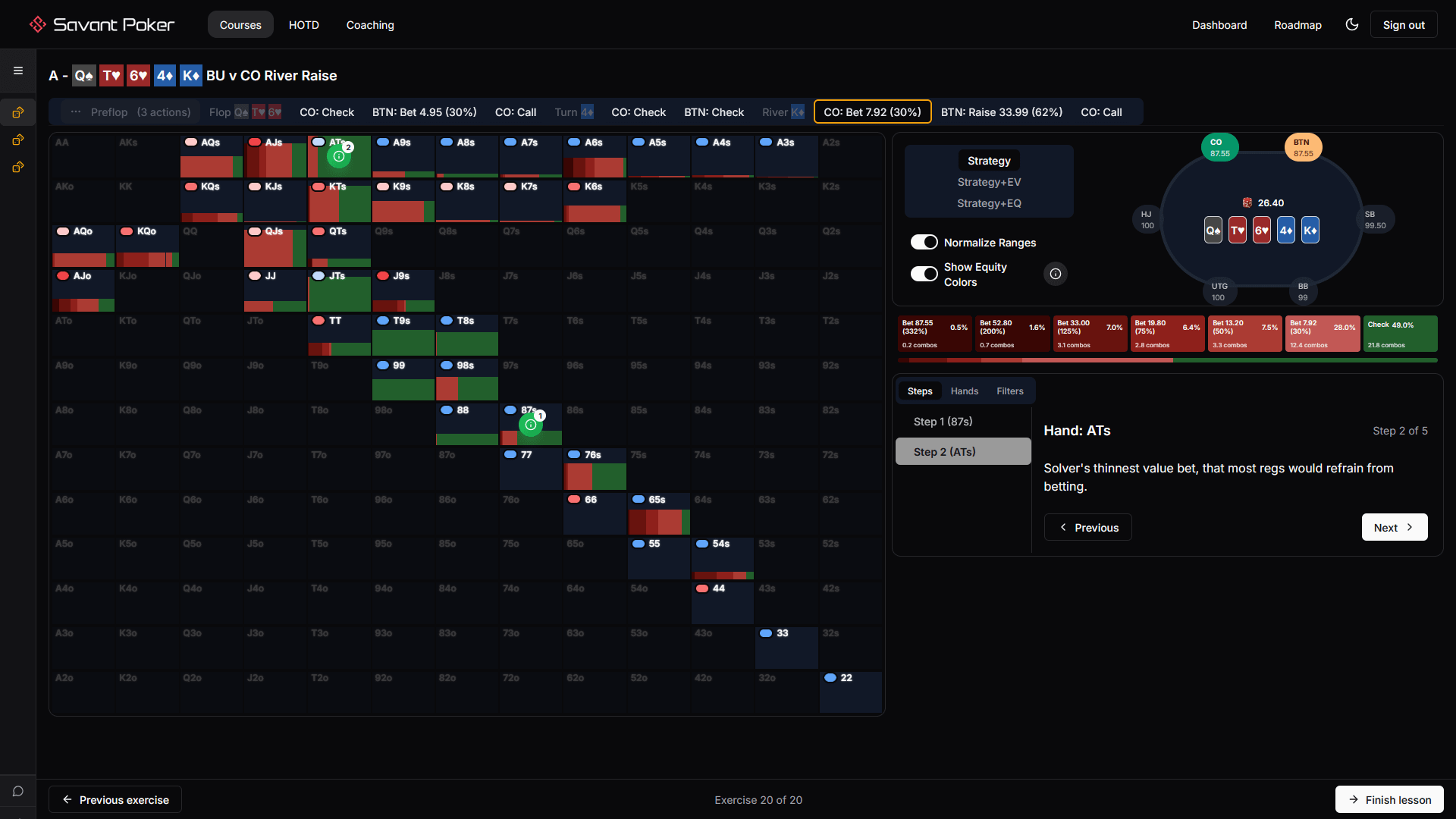
The K♦ is a good river card for IP, who gains many new strong hands like top pairs. By contrast, OOP has many hands like Qx second pairs that drive the small bet size.
OOP has then a clear preference for the block (30%) size when betting, as they're trying to get value with value bets as thin as ATs.
But clearly, regs do not play like solvers.
-
By the Numbers: when regs bet small, data shows they don’t defend their range with enough strong hands.
-
In addition, they tend to massively over-fold against raises.
K7s: even if regs don't value bet as thin as solver does, they'll still have to defend with weak bluff-catchers.
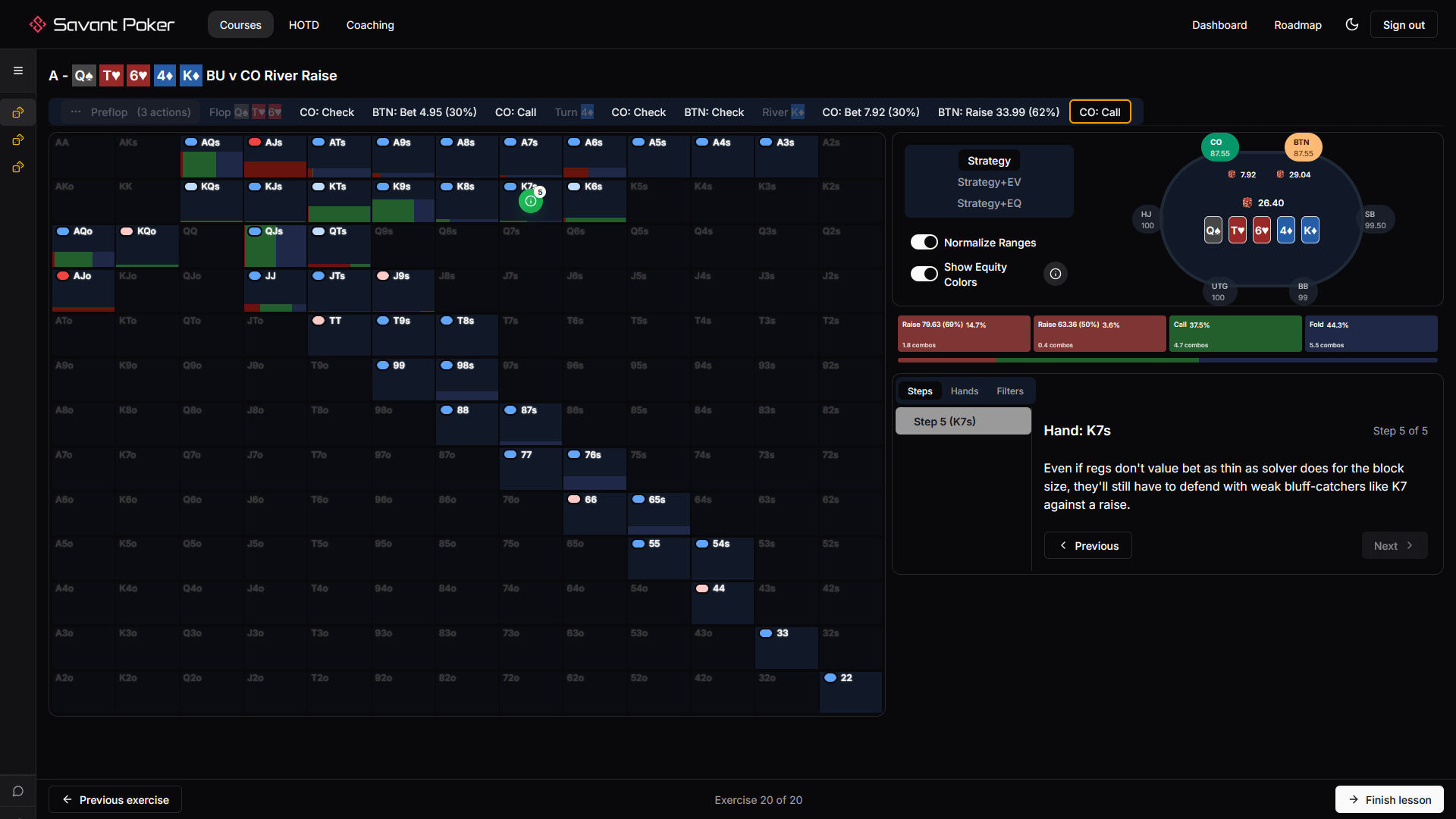
Looking at their defending range against a medium-sized river raise, you’ll see that solver bluff-catches with tons of weak hands like K7, QJ, and pocket jacks.
Regs might not bet thin enough on the river, but they also won’t have enough strong hands like AJ and two pairs in the mix.
From mass data in this line among many others, we know regs do not like bluff-catching with weak hands against river raises.
-
Regs over-fold by around 10% when they bet small and get raised in this line. Despite this, the average reg under-raises and under-bluffs.
-
The red line crushers, however, take full advantage of this exploit and bluff-raise rivers like this one aggressively.
👉 There’s More To Consider
As some people in my youtube comments correctly pointed out, river bluff-raises do not always work long-term.
- Regs likely over-fold against them because they perceive them to be under-bluffed, and just a few aggressive showdowns could change that.
Plus: river raises aren’t always easy to implement. For example, consider BTN’s raising strategy in this spot, Q♠ T♥ 6♥ 4♦ K♦:
JJ: a premium combo to turn into a bluff here, double blocking OOP's nuts.
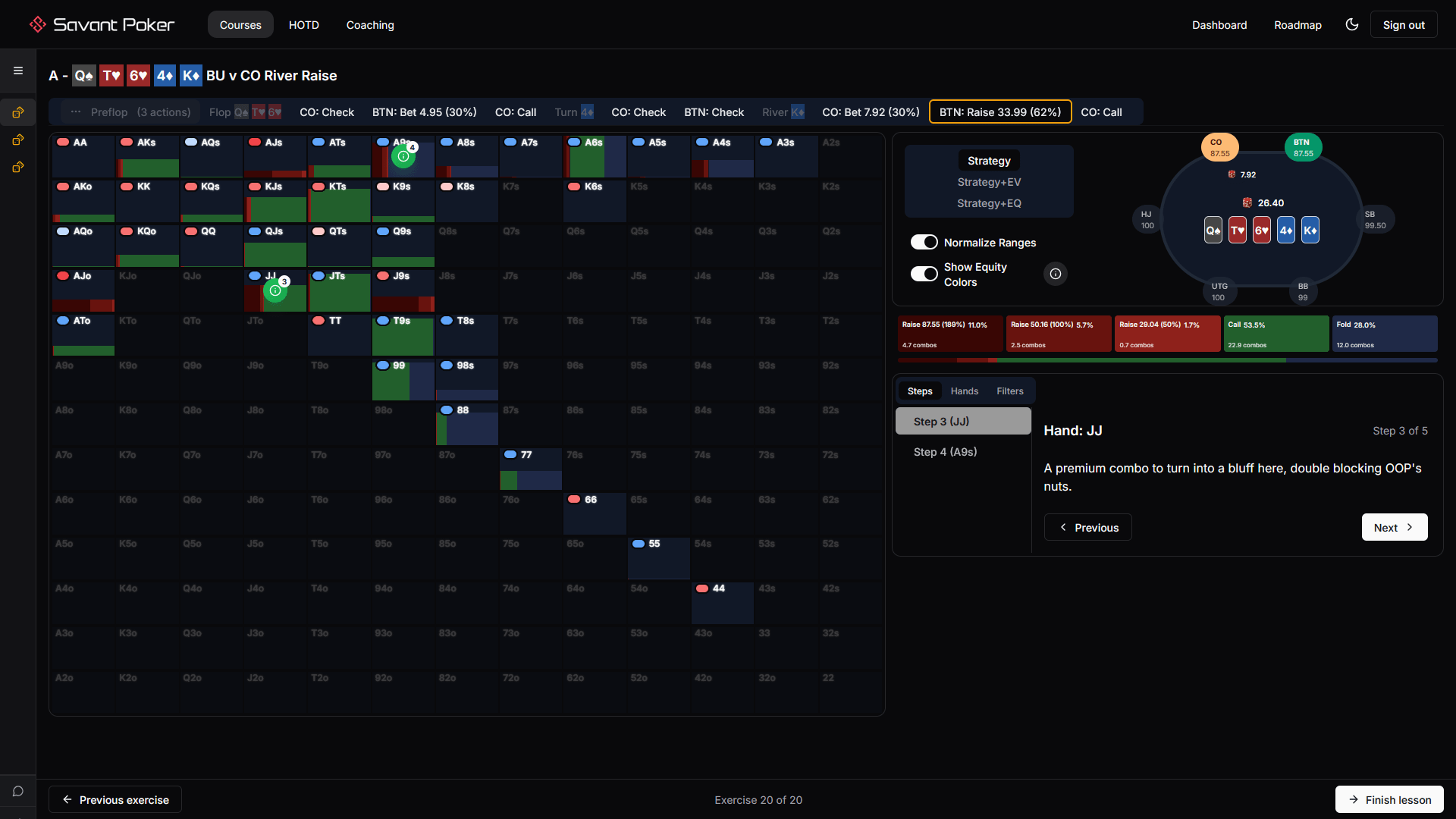
As you can see, it contains many unintuitive hands like JJ and A9. And it’s not fully clear that these are the best bluff-raises in-game either, as villain’s real-life calls/folds will differ from solver’s.
So I’ll leave the questions to you:
-
What hands would you bluff-raise here?
-
Do you think bluff-raising rivers is a reliable strategy long-term? Why or why not?
-
In what circumstances do you think bluff-raising rivers is bad?
Curious to hear your thoughts on this one 🙂
– Gleb @ Savant Poker